
One of the most enduring myths about horses is that hanging cheek snaffles give you some degree of poll pressure. This simply isn’t true – and here’s why:
1. In order for any bit to give you poll pressure, it needs to act as a lever.
2. A lever works by having a fulcrum (a fixed point), with an arm which pivots round the fulcrum:
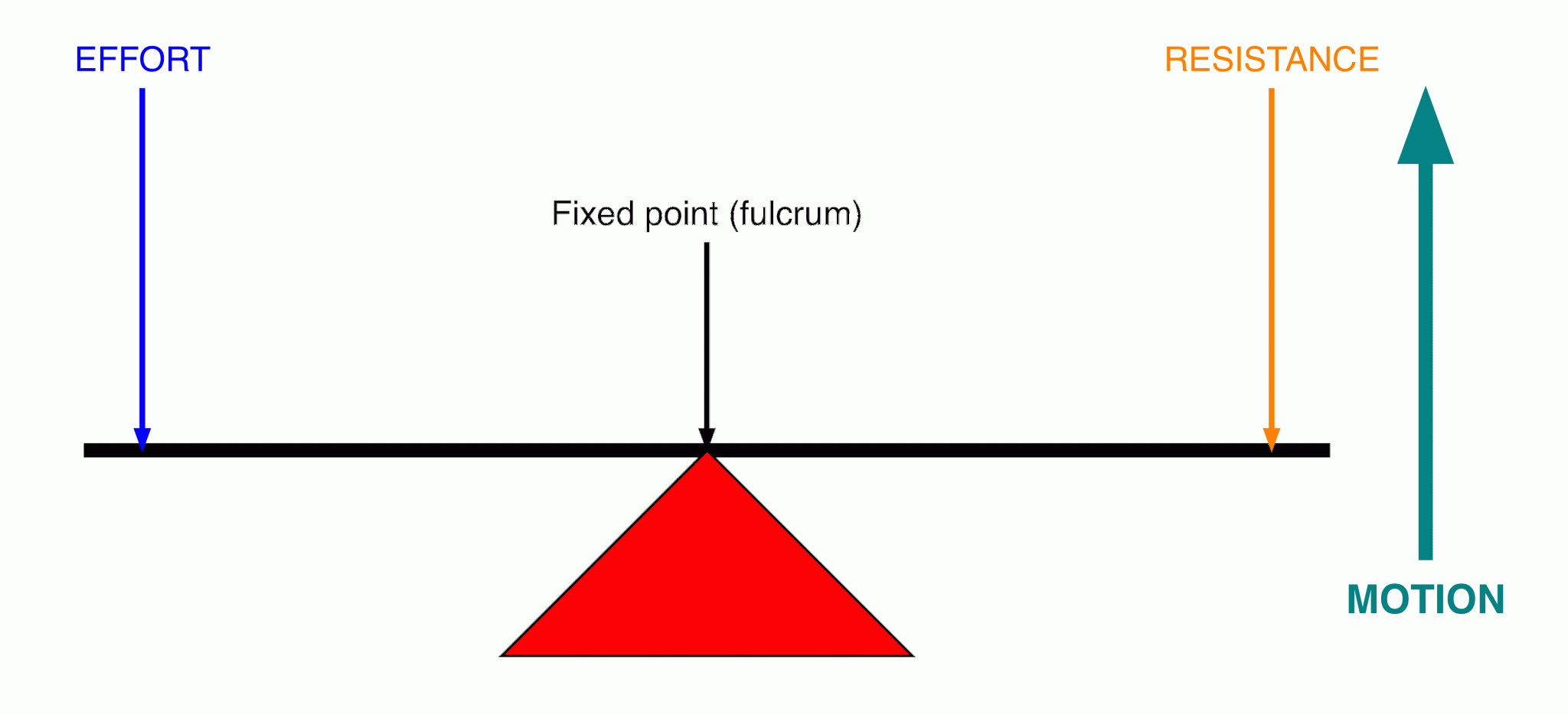
A basic lever (click to see larger)
The mouthpiece of the bit is the fulcrum, the effort comes from the rider’s hands down the reins, and the resistance is provided by the poll.
Because the reins on a hanging cheek snaffle are free to move around the bit ring, as you increase the effort down the reins, they move round the bit ring to remain in line with the fulcrum.
Thus no matter how much effort you use, you will never affect the area of resistance. A good analogy is that it is like sitting in the middle of a seesaw and your friend pushing down on one of the seats – no matter how much effort they use, you will never move.
In contrast, curb bits like a weymouth or a pelham have a lever arm below the fulcrum (the mouthpiece), so as you increase effort down the reins, you increase the force acting on the point of resistance (the poll).
This isn’t a debate. No matter what the new FEI rules say, or the reasons behind them, hanging cheek snaffles simply cannot produce poll pressure, unless the FEI have also managed to alter the laws of physics.
UPDATE: The FEI have backtracked on their rule change regarding hanging cheek (and straight bar) snaffles. Maybe they realised you can’t change the laws of physics to fit your world view?!


Thank goodness someone has said this. You only have to watch one in action, pressure on the reins if anything actually causes the rings to lift and therefore reduce poll pressure, not increase it.
Perhaps the bit against the jaw becomes the fulcrum with the rein being below the bit. I’m not a physicist and presume the only way of knowing for sure would be some sort of pressure sensor. I do know there is a leverage effect from the bit that distorts the feel at the end of the rein.
No pressure sensor required! There’s no way a hanging cheek can give any leverage – if you look at this picture of WFP riding Chilli Morning (in a full cheek snaffle) vs this picture of him at WEG in a hanging cheek snaffle, you can clearly see that the line from the rein to the mouthpiece (i.e. the fulcrum) is the same. In both cases, the rein is in a straight line which would intersect with the mouthpiece. The small rings on the hanging cheek which the cheek pieces attach to allow the bit to pivot in the horse’s mouth, but the line of the cheek piece is the same in both cases, the hanging cheek bit has simply pivoted in the mouth in comparison to the full cheek.
Now if we look at a picture of a double bridle, we can see that the rein going to the snaffle (bradoon) has exactly the same features as the two snaffles above – rein in line with the mouthpiece. Whereas the Weymouth has the rein below the mouthpiece and so gives leverage on the poll.
Class 2 levers, like for example a wheelbarrow, do give leverage without the effort arm being below the fulcrum, but they rely on the effort arm and the resistance arm both being attached to a fixed point on the fulcrum. This simply doesn’t happen with the hanging cheek snaffle because the rein can slide round the bit ring, and the cheekpiece slides on the small ring, which allows the bit to pivot. If the handle of a wheelbarrow was attached round the wheel rather than to a fixed point (the axle) in the middle of the wheel, and if the bucket of the barrow was attached similarly to a ring at the top of the wheel, then it would work pretty much exactly as a hanging cheek snaffle does, and you would get no leverage at all.
The feel may well be different from a hanging cheek, and there are several possible reasons for this, but none of them are to do with it creating any kind of leverage.