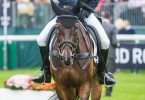
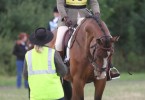
Regular contributor Sandra Blampied of www.osteopathyforhorseriders.co.uk today writes about how to improve your mobility to improve your sitting trot something that will help the vast majority of riders including myself!
Does the thought of having to perform a dressage test in sitting trot fill you with dread? No matter how much you trot around the school without your stirrups trying to deepen your seat you know that to any long suffering judge you probably look more akin to a thellwell cartoon than that image of Carl Hester you were aiming for.
Being able to sit to your horses trot no matter how big a stride is all about mechanics, and not just the horses but yours too. In order to absorb the movement of your horse’s spine you have to have movement in your own spine. If you spend most of the day feeling as stiff as a board then you are not going to be able to “sit” to a big moving trot. The curves in the human spine have developed over thousands of years to enable your body to absorb forces applied in an axial direction. As an example if you think of a straight metal rod compared to a metal spring, if you apply a force to either end of both the spring will take a much higher load than the straight rod before it breaks. As with horses there is an anatomical normal in people although, maybe due to my line of work, I very rarely see this! The ideal is a nice even pair of curves in your lumbar and thoracic spine, what you usually get is some variation of this, either a very straight spine, a very curvy spine or a mixture of the two!
Sadly if you have been blessed (or cursed?) with a spine of a far straighter design then you are already on a back footing and for you pelvic mechanics (which is another post entirely) will be the key to sitting trot. For those of us with a nice deep lumbar curve it is still important that there is movement in that curve and you are not rigid and stiff through your muscles and spine.
So how can you go about helping to improve this? Well stretching is a good place to start, simple knee hugs and side stretches well help keep your muscles relaxed. If this isn’t sufficient you may well benefit from a visit to a professional such as myself for a deeper massage and mobilisation treatment to help things out a bit. Once you are on the right track then I would highly recommend you find a weekly Pilates class, ideally one aimed at horse riders. It is all very well me promoting mobility of the spine but the second key element is having strength in your core to control that mobility. A mobile spine but weak core is a recipe for injury !
So in summary if you want to sit to that huge trot of your horses you need to be able to move with it and absorb the movement, this will only truly happen if your own spine is free and mobile.